
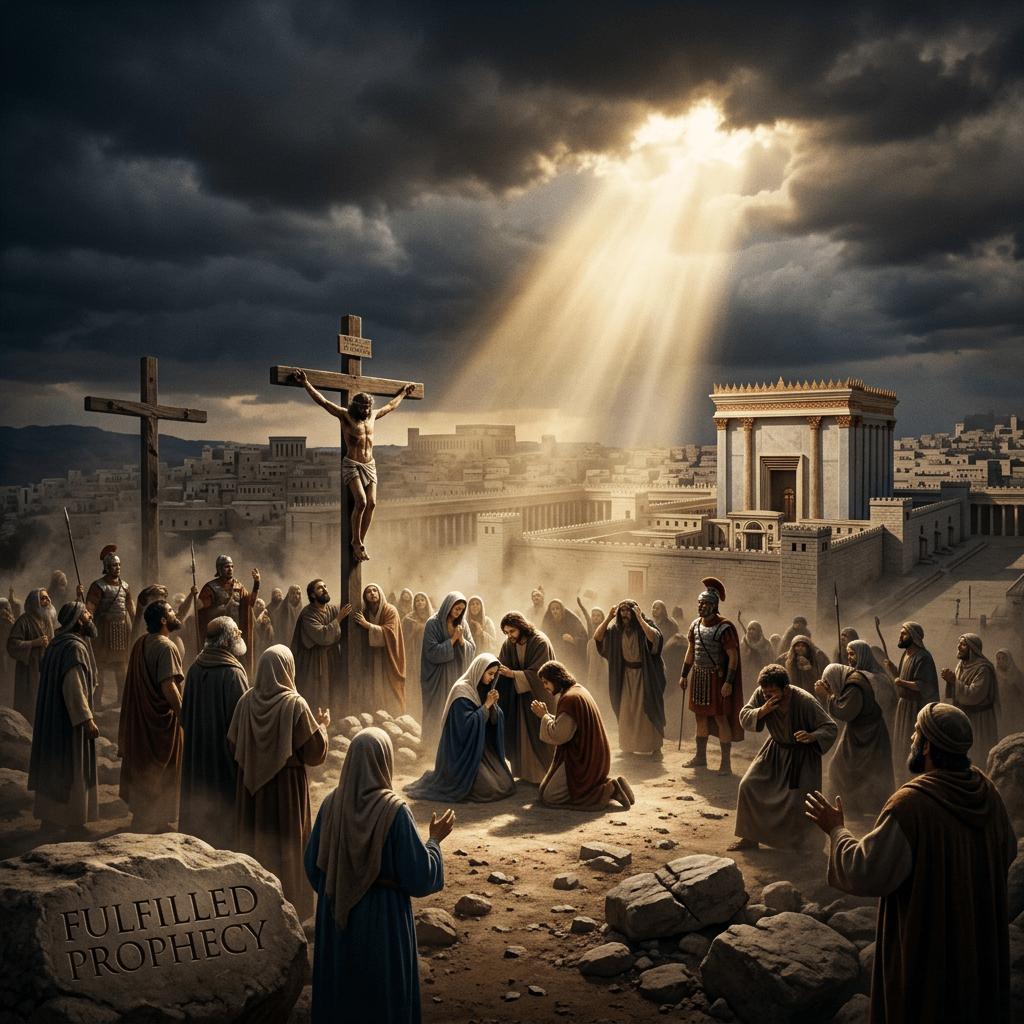
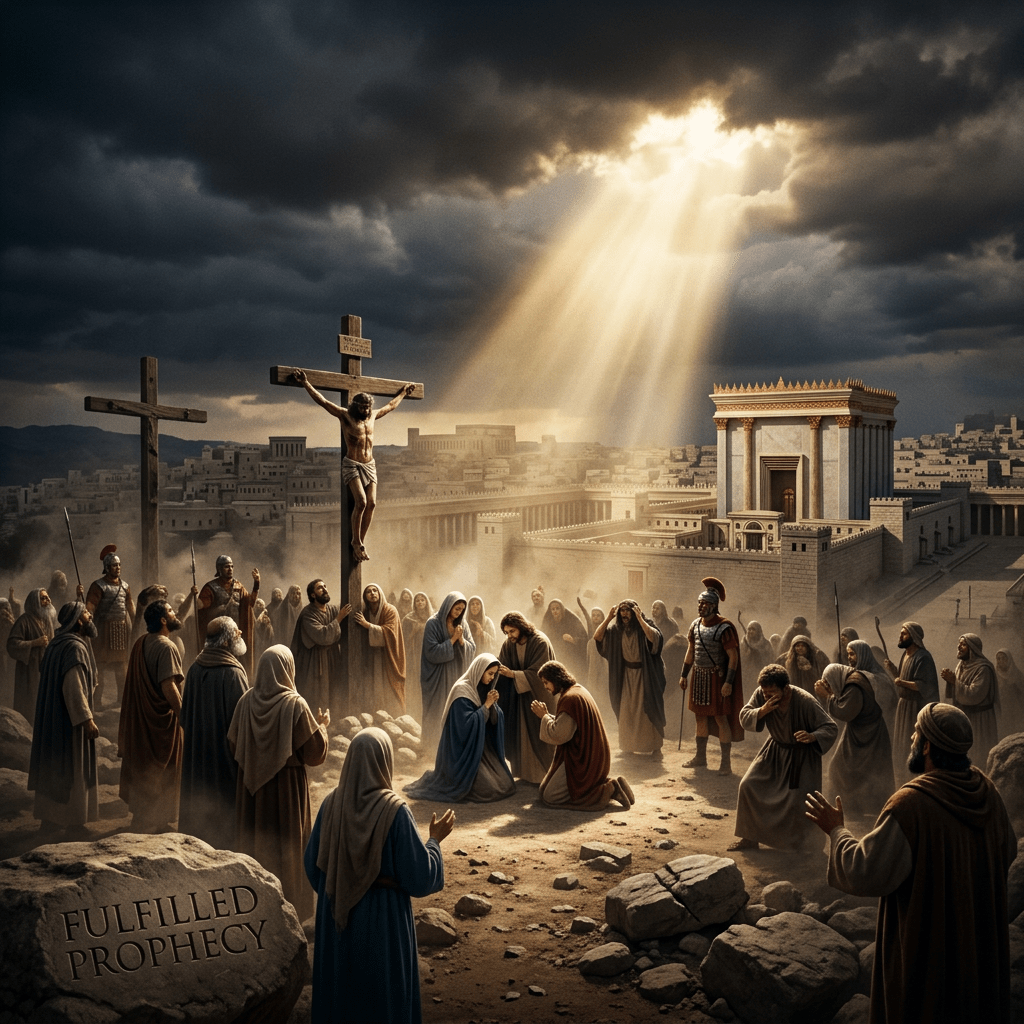
Daniel 70-week prophecy is astounding. Daniel and the Jewish people were held captive in Babylon for seventy years because of their rebellion against God. Daniel was reading the writings of Jeremiah searching for the length of time this captivity would be. He began to pray and fast confessing to God his sins and the Sin of Isreal when suddenly he was touched by Gabriel the Arch Angel of God…
“Yea, while I speaking in prayer, even the man Gabriel, who I had seen in the vision at the beginning caused to fly swiftly, touched me about the time of the evening oblation. And he informed me, and talked with me, and said, Oh Daniel, I am now come forth to give thee skill and understanding. At the beginning of your supplications the commandment came forth, and I am come to show you; for you are greatly beloved: therefore, understand the matter and consider the vision.”
Then Gabriel gave him the understanding that we today can do our math to see what exact time the Messiah would would step into earth’s history.
We must read Daniel 9:24-27 to get the whole picture then we shall break it down using “Non-Christian sources in history to see with the countdown began.”
“Seventy weeks are determined upon they people and upon the holy city, to finish the transgression, and to make an end of sins, and to make reconciliation for iniquity, and to bring in everlasting righteousness, and to seal up the vision and prophecy, and to anoint the most Holy”. Daniel 9:25.
This one prophecy sums up all history from Daniel’s day until Jesus himself is anointed King of Jerusalem at the end of the tribulation period. All prophecy will have been fulfilled, nothing left to complete and everlasting righteousness will be on the earth.
You and I know that has not happened yet so where exactly are we in this timeline?
“And after threescore and two weeks, (62 weeks) shall Messiah be cut off, (Crucified) abut not for himself (not because of his doing) and the people of the price that shall come shall destroy the city and the sanctuary: (Romans 70 AD) and the end thereof shall be with a flood, and unto the end of the war of desolations are determined” (Jews were scattered all over the earth for 2000 years until 1948”.
And he shall confirm (antichrist) a Covenant with many for one week: and in the midst of the week, he shall cause the sacrifice and oblation to cease, and for the over spreading of abominations he shall make it desolate, even until the consummation, and that determined shall be poured upon the desolate.”
This passage suggests there will be a 3rd temple built that the antichrist shall disgrace. That temple is not built yet, but the Jews have returned to their land in 1948 and are recognized as a sovereign nation. There is a prophecy in the Gospels that Jesus himself spoke that says when the Jews are returned to Isreal and it begins to “blossom” again, Jesus said “that generation shall not perish until the second coming of the Lord.
Now let us do the math so we can see where we are in our day.
Using secular history
Chapter Segment: The Chronological Alignment of Daniel 9
The mathematical precision of Daniel’s seventy-weeks prophecy presents a striking intersection between biblical text and established secular chronology. The Hebrew term shabuim designates “weeks of years,” creating a prophetic framework of 490 years (70 weeks × 7 years). Daniel 9:25 isolates a specific window of 69 weeks (483 years) spanning from the issuance of a decree to restore Jerusalem until the manifestation of the Messiah.
Secular history provides two compelling frameworks for this timeline:
- The Solar Chronology (Artaxerxes I): Astronomical records from Ptolemy’s Canon and the writings of Greek historian Herodotus firmly establish the accession of Persian King Artaxerxes I in 465 BC. His seventh year, noted for his decree empowering Jerusalem’s civil government, lands precisely in 457 BC. Measuring 483 solar years forward from this baseline—accounting for the lack of a year zero—brings the timeline directly to 27 AD, the historically accepted commencement of Jesus of Nazareth’s ministry.
- The Prophetic Chronology (Nehemiah): In secular history, Artaxerxes’ twentieth year is pinned to 445/444 BC, the date of his decree allowing Nehemiah to rebuild Jerusalem’s defensive walls. Utilizing the ancient 360-day prophetic calendar common to Babylon and early Jewish reckoning, 483 years translates exactly to 173,880 days. Projecting this interval forward from the decree date terminates in the spring of 33 AD, the exact year accepted by a vast consensus of historians for the crucifixion.
While secular, historical-critical academics view this alignment as a retrospective calculation composed during the Maccabean crisis (c. 167–163 BC) to mirror contemporary events, the literal correlation between Persian state decrees and the timeline of early Christianity remains a cornerstone of chronological study.
Chapter Segment: Daniel and the Qumran Library
The discovery of the Dead Sea Scrolls provided monumental text-critical evidence for the antiquity of the Book of Daniel. Far from being a minor text, Daniel was heavily integrated into the library at Qumran, represented by eight distinct manuscript fragments across Cave 1 and Cave 4. Collectively, these highly fragmented scrolls contain text from every single one of Daniel’s twelve chapters.
For historians and textual critics, the Qumran discoveries yielded several vital insights:
- Linguistic Consistency: The standard biblical text of Daniel features a highly unique bilingual architecture, shifting seamlessly from Hebrew to Aramaic in chapter 2, and returning to Hebrew in chapter 8. The Qumran fragments mirror these precise linguistic pivots, proving that this bilingual structure is not a modern editorial artifact but an ancient, intrinsic feature of the text.
- The Chronological Constraint: Paleographical analysis dates the oldest Daniel scroll found at Qumran (designated 4QDan-c) to the late second century BC—approximately 125 BC.
This physical timeline alters the landscape of academic debate. For secular historians operating on the historical-critical model (which posits a composition date of roughly 165 BC), the Qumran discovery proves the text was copied, distributed, and venerated as scripture within a remarkably tight forty-year window. Conversely, conservative textual scholars argue that such rapid, widespread acceptance across multiple copied manuscripts points to an established text with far deeper historical roots
Step 1: Decode the Prophet’s Code (Weeks = Years)
In the ancient world, the Hebrew word for “week” (shabua) simply meant a group of seven, just like the word “decade” means a group of ten. [1, 2, 3]
- When Daniel says “70 weeks,” he does not mean 70 literal weeks of days. He means 70 blocks of 7 years.
- The Math: 70 weeks × 7 years = 490 years total. [1, 2, 3]
The prophecy breaks this 490-year countdown into smaller chunks. It tells us exactly how long it will take for the Messiah to arrive: [1, 2, 3]
- 7 weeks (49 years) + 62 weeks (434 years) = 69 weeks.
- The Arrival Math: 69 weeks × 7 years = 483 years. [1, 2, 3, 4]
So, the master timeline is simple: From a specific royal decree to the arrival of the Messiah, it will take exactly 483 years. [1]
[ START: The Decree] ─────── ( Wait 483 Years END: The Messiah would be revealed ]
Step 2: Pick the Starting Line
To start a countdown, you need a calendar date. The prophecy says the timer starts when a decree is issued to rebuild Jerusalem. History gives us a concrete date for this. [1, 2]
- The Ruler: King Artaxerxes I of Persia.
- The Secular Date: Ancient records (like Greek histories and astronomical logs) prove he took the throne in 465 BC.
- The Decree: In his 7th year as king, he issued a royal decree allowing the Jews to rebuild their community (found in the biblical book of Ezra, chapter 7).
- The Starting Year: 457 BC. [1, 2, 3, 4, 5]
Step 3: Do the Math to Jesus
Now, we simply count “forward” 483 years from our starting line of 457 BC. This is found in the Book of Nehimiah 1
Going back to 457 (BC Starting Year)
+ forward 483 BC (Prophetic Years)
_______
26 AD + 1 (Add 1 year because there is no “Year 0” in history) Brings us to Reaches this date: 27 AD
The Destination: 27 AD.
Step 4: Look at the History Books
What happened in secular and biblical history in 27 AD?
This is the exact year Jesus of Nazareth came out of the wilderness, was baptized by John the Baptist, and began his public ministry. The word “Messiah” literally means “The Anointed One.” In Jewish tradition, kings and prophets were anointed with oil to start their work. Christians believe Jesus was “anointed” by the Holy Spirit at his baptism in 27 AD to begin his mission. [1, 2, 3, 4, 5]
The clock struck exactly on time.
Alternative Countdown: The 360-Day Shortcut
Some historians use a slightly different starting point—the year 444 BC, when the same king gave Nehemiah permission to rebuild Jerusalem’s physical walls. Because ancient calendars (like the Babylonian one Daniel lived under) used 360-day years instead of our 365-day solar years, the math adjusts: [1, 2, 3, 4, 5]
- 483 years × 360 days = 173,880 days total.
- If you count exactly 173,880 days forward from that 444 BC decree, you land precisely on the spring of 33 AD.
- This is the exact year secular and biblical historians agree Jesus rode into Jerusalem on a donkey (Palm Sunday) and was crucified days later. [1, 2, 3]
Whether you use the solar calendar or the ancient 360-day calendar, the timeline lands squarely on the lifetime of Jesus of Nazareth!
Even if you don’t believe in the Bible, do you believe in simple math?
you can search out Nehimiahs kings and history in secular history books and still come to these exact dates.
There is only one conclusion you come to, The Bible is inspired by God and this prophecy points to only one person in all history who fulfills all of it…Jesus of Nazerath.
Jesus asked this quesiton “Who do you say that I am?”
Writings of PJ Hanson.


Leave a Reply